

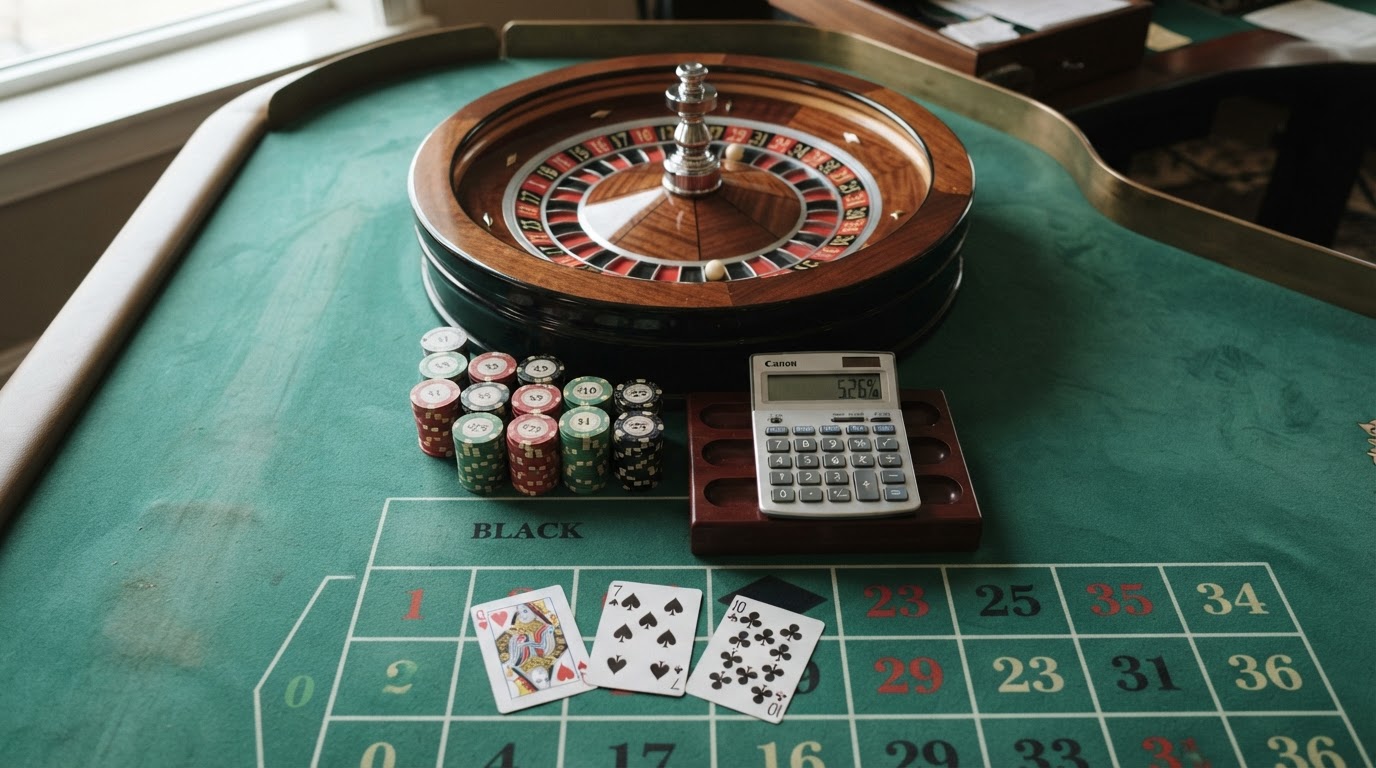
If you’re looking at table casino games, you might wonder what the house edge means for your money. Does it tell you what you’ll lose today, or simply how a bet works over time? The distinction matters. We’ll explain how the edge is calculated, why it varies between bets and why even a low edge cannot predict your next result. You can explore these games for entertainment without treating gambling as a way to make money.
What is the house edge in table casino games?
The casino’s average mathematical advantage
The house edge is the average percentage of the total amount wagered that a bet is expected to lose over a very large number of repetitions. It comes from the relationship between the probability of each possible outcome and what the bet pays when it wins.
Imagine a bet where a win pays less than it would need to pay for the bet to break even over the long run. That difference gives the casino a mathematical advantage. It doesn’t mean the casino wins every bet, or that every player loses. It means the average result favors the casino when the bet is repeated many times.
The important phrase is total amount wagered. That is not necessarily the amount you bring to the table. If you bring $20, make a $5 bet and win, you can use some of the same money to make another bet. Both wagers count toward your total, even though you started with only $20.
House edge is not a prediction for one session
Individual sessions of table casino games can end in a win, a loss or something close to where you started. The house edge describes an average across many repetitions, not a result you should expect to see neatly reflected in every visit.
A lower edge means a lower expected loss per unit wagered; it does not guarantee a win. A bet with a small edge can still produce a substantial loss, especially if you make many wagers or experience a losing streak. Equally, a bet with a higher edge can win in the short term.
How do you calculate expected loss?
Use the house edge with your total wagers
For a specified bet, the basic calculation is expected loss = total amount wagered × house edge. Convert the percentage to a decimal before multiplying: an edge of 2.70% becomes 0.027.
Suppose you place 100 bets of $5 each. Your total amount wagered is $500. If every bet has an edge of approximately 2.70%, the calculation is $500 × 0.027, or about $13.50 in expected loss.
That $13.50 is not a fee taken from your balance, and it is not necessarily what you will lose. It is the average implied by those conditions over a very large number of comparable sets of wagers. In one session, you could lose more, lose less or finish ahead.
To work out an edge from scratch, you also need the probability and net payout of every possible result. Multiply each net result by its probability, then add those figures together. If the average is negative for the player, express the loss as a percentage of the wager to find the house edge.
Why bet size and time at the table matter
Two people can face the same edge in table casino games but have different expected losses because they wager different amounts. Doubling each bet doubles the expected loss for the same number of bets. Making more bets also increases the total amount wagered, even if each individual bet stays small.
Time matters because a longer session usually gives you more opportunities to wager. How many bets you make per hour depends on the game and how you play, so time alone is not enough to calculate your expected loss. More play also gives your actual results more room to vary. It never makes a win “due.”
How does the house edge differ across table bets?
The figures below are useful comparisons, not recommendations. In table casino games, the exact bet, payout and rules determine the edge. Check those details before comparing one option with another, especially when a table offers unusual rules or extra wagers.
Roulette: check the number of zeros
A standard single-zero roulette wheel has 37 pockets: numbers 1 to 36 and one zero. On most standard bets, its house edge is approximately 2.70%. A standard double-zero wheel has 38 pockets, including both zero and double zero. On most standard bets, the edge is approximately 5.26%, assuming the usual payouts.
For example, a winning bet on one number normally pays 35 to 1, meaning $35 in profit for a $1 bet, with the original $1 returned. On a single-zero wheel, that number has one chance in 37 of appearing. The payout does not fully offset the other 36 possible outcomes, which is where the edge comes from. The roulette overview on Wikipedia explains the wheel layouts and standard payouts.
Special bets and rules can produce different edges, so don’t assume every space on a layout has the same value. Look at the wheel, the available bets and the payout table together. You can also explore online roulette to learn more about how the game works.
Baccarat: compare banker and player bets
In standard baccarat, you can bet on the banker hand, the player hand or a tie. These are the names of the hands being compared; betting on the banker does not make you the casino. Under standard rules, the banker bet has an edge of approximately 1.06% when a 5% commission applies to winning banker bets. The player bet has an edge of approximately 1.24%.
A tie generally pushes banker and player bets, meaning those wagers are returned rather than won or lost. The tie bet itself generally has a much higher edge, depending on its payout. Commission-free versions can change the comparison by adjusting how certain banker wins are paid, while side bets have their own rules and probabilities. The baccarat overview on Wikipedia describes the standard bets and their odds.
For more context before comparing tables, read how baccarat works and the mathematics behind it.
Blackjack: rules and decisions both matter
Blackjack differs from many table casino games because your decisions affect the expected result. Basic strategy is a set of mathematically derived decisions for situations such as whether to take another card, stand or split a pair. It depends on the rules in use and aims to reduce the house edge; it does not guarantee a profit.
Before playing, check the payout for a natural blackjack: an ace and a ten-value card as your first two cards. A table paying 3 to 2 returns $15 in profit on a $10 winning natural, while a 6-to-5 table pays $12. Also check whether the dealer must hit or stand on a soft 17, a hand totaling 17 that contains an ace counted as 11. Other rules, including when you may double or split, matter too. The blackjack overview on Wikipedia explains common rules and their effects.
Because both rules and decisions matter, a single universal blackjack edge would be misleading. A published figure based on accurate basic strategy may not describe someone playing a different table or making different decisions.
What should you check before choosing a table?
Read the rules and payout table
Before placing a bet on table casino games, identify the exact wager you’re considering and check what it pays. Look for commissions, exceptions and special rules as well as the headline game name. A payout expressed as “to 1” usually describes the profit on a winning bet, with the original stake returned separately; confirm how the table presents its payouts.
Side bets are extra wagers offered alongside the main game. They can be appealing because they may pay more on a rare outcome, but they have a different edge and often a higher one than the main bet. A large potential payout on its own does not tell you whether a bet has a low or high edge.
If you find a worked example online, compare every assumption with the actual table: wheel type, payout, commission and any special conditions. Figures from one version of a game should not automatically be transferred to another.
Set limits before you play
Decide how much money and time you’re comfortable spending before you start, and stop when either limit is reached. Only play with money you can afford to lose. Keep gambling money separate from what you need for bills, savings and other commitments.
Don’t chase losses by increasing your bets or continuing beyond your limit in the hope of getting the money back. If you play online, deposit limits, cooling-off periods and self-exclusion may be available as additional controls. You can read more about understanding safe gambling limits and consider which tools fit your situation.
Common misunderstandings about the house edge
“A low edge means I’m likely to win today”
A low edge makes a difference to the long-run expected loss, but it does not tell you the probability of finishing a particular session ahead. That probability also depends on factors such as the bet’s possible payouts, the number of wagers and your stopping point. Short sessions of table casino games can produce a wide range of outcomes, including losses that are much larger than the expected average.
“A losing streak means a win is due”
For independent outcomes, previous results do not change the odds of the next result. On a standard roulette wheel, for example, a run of red results does not make black more likely on the next spin. Each spin is a separate event, assuming the wheel operates as expected.
That explanation should not be applied blindly to every situation. In card games where cards are dealt without replacement, the remaining cards can change the probabilities of later hands or draws. Even then, a past loss by itself does not mean your next bet is owed a win.
“A betting system can remove the edge”
Changing your bet size after a win or loss does not change the underlying edge of an otherwise unchanged bet. A progression may alter the pattern of wins and losses, but larger wagers also increase the amount at risk. A losing streak can reach your spending limit or the table’s maximum before the progression produces the result you hoped for.
The same principle applies across table casino games: a system for deciding how much to bet is different from a rule or decision that changes the probabilities or payouts. Neither a progression nor a chart of past independent results turns a negative-expectation bet into a reliable source of income.
Frequently asked questions
Is the house edge the same as return to player?
They are complementary long-run measures for a specified bet. Return to player, or RTP, is the average percentage of total wagers returned to players across the possible outcomes. An edge of 2.70% corresponds to an RTP of 97.30%, assuming both figures use the same bet and calculation basis.
Neither figure predicts what will happen in your session. An RTP of 97.30% does not mean you will receive exactly $97.30 back for every $100 you wager.
Which table game has the lowest house edge?
There is no single answer without specifying the bet and its rules and, where relevant, the player’s decisions. Some bets in table casino games have relatively low published edges, but a different payout, commission or strategy assumption can change the comparison.
Compare like with like: use figures for the same type of wager and check whether they account for the same rules and player behavior. Also remember that a low edge is only one part of deciding whether a game fits your budget and expectations.
Can you calculate your exact loss from the house edge?
No. You can calculate an expected long-run average for a given amount wagered, but you cannot determine your exact result in advance. Random outcomes can leave you above or below that average, and the amount you actually wager may also change as you play.
Understanding the edge gives you a clearer way to compare casino games, not a way to predict them. Take your time, check the specific rules and explore more casino guides when you want to learn about another game.