

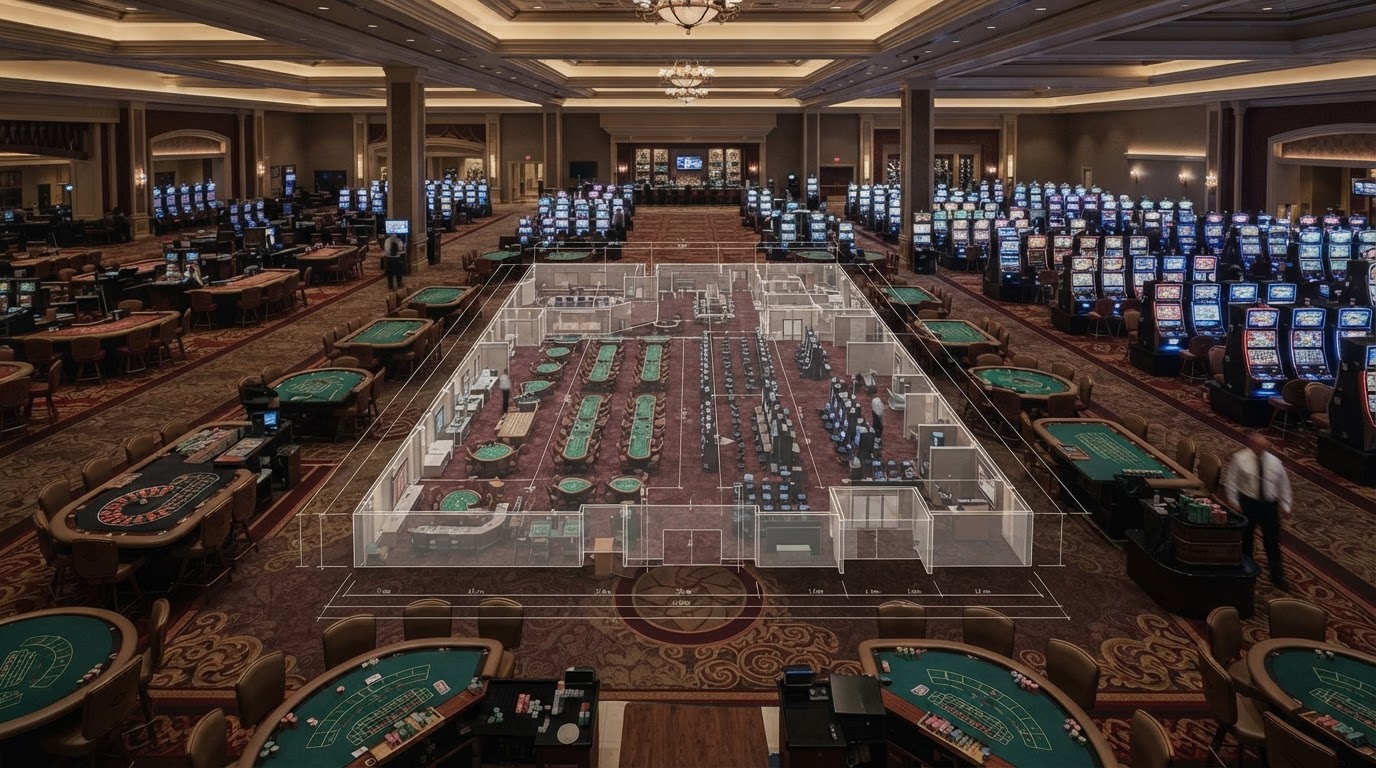
When someone mentions the biggest casino, what do they actually mean: the most space for games, the most machines or the largest resort? Each is a reasonable way to describe size, but each can produce a different answer. To compare claims fairly, you need to check the measurement, the property boundaries and the date of the information.
What does “biggest casino” mean?
There is no single measurement that answers every question about casino size. A venue might have an expansive gaming floor but a relatively small hotel. Another might be part of a vast resort with thousands of rooms, while dedicating less space to gambling. Neither description is necessarily wrong; they are just measuring different things.
Gaming floor versus the whole resort
Gaming floor area is the space designated for casino games, as defined by the source reporting it. It can include areas for slot machines, table games and other gambling activities. What sits around those games, such as aisles or lounges, may or may not be included in a published figure.
Total resort area is a broader measure. Depending on how it is reported, it can include hotels, restaurants, shops, theatres, convention halls and other facilities. The biggest casino by gaming floor area is not automatically part of the largest resort by total area.
If you are new to the distinction between casino games and the facilities around them, our guide to the basics of casino gambling provides some helpful background.
One property versus a wider complex
Property boundaries matter as much as the measurement itself. One source might count the gaming space in a single building, while another combines several connected buildings under one resort name. A wider complex could even contain separate venues that operate under different licences or have different entrances.
Before deciding which is the biggest casino, check whether each figure describes a single property, a connected complex or several venues combined. Operators do not always use those terms in the same way, so a property description is more useful than its name alone.
Which measurements can be used to compare casinos?
Gaming floor area
If your question is about the physical space available for gambling, gaming floor area is usually the most relevant starting point. You may also see it called gaming space or casino floor area. The largest casino by gaming floor area is the one with the most qualifying space under the definition being used, not necessarily the most rooms or facilities elsewhere.
The difficulty is that the definition of qualifying space can vary. A published figure might include walkways, private gaming rooms or lounges, while another might count only areas immediately occupied by games. Some sources may not explain their method at all. If the boundaries are unclear, treat the comparison as approximate rather than decisive.
Units also need attention. One square foot is approximately 0.093 square metres, as you can verify using the conversion on Wikipedia’s square foot reference. To convert square feet to square metres, multiply by approximately 0.093; to convert square metres to square feet, multiply by approximately 10.764. Keep the original figures and source notes alongside your calculation so you can check what was measured.
Number of gaming machines and table games
Game counts offer a different view. The number of gaming machines can tell you roughly how many machine positions a venue offers, while a table-game count describes another part of its selection. Neither count, on its own, identifies the biggest casino by floor area.
For example, machines can be arranged more closely in one venue than in another. A casino with fewer machines might use more space for table games, walkways or gaming lounges. Counts can change when games are added, removed or replaced, and a source may not make clear whether its figure refers to installed games or those currently available to play.
Total resort footprint and facilities
Total property area, hotel room counts and entertainment facilities help describe the wider destination. They can be useful if you want to compare the scale of two resorts rather than just their gaming areas. Still, a hotel room count tells you little about the size of a casino floor.
Be careful with the word “footprint,” too. A land area or building footprint measures ground covered, while total floor area can add together space across several levels. Those figures are not interchangeable. A biggest casino resort versus gaming floor comparison should make clear which of those measurements is being used on each side.
Visitor capacity or revenue
Visitor capacity describes how many people a venue is permitted or designed to accommodate, depending on the figure’s definition. It can reflect safety rules and the layout of the space, not just the area devoted to games. A stated capacity may also cover the entire property rather than the casino floor.
Revenue measures business activity, not physical size. A casino can generate more revenue than a larger venue because of differences in its customers, games, prices or operating conditions. If you see revenue used in a ranking, check what kind is being reported and the period it covers; it does not establish which venue has more gaming space.
Why do “world’s biggest casino” rankings differ?
Sources may measure different things
Two rankings can appear to disagree even when both use accurate figures. One may compare gaming floor area, while another counts the total area of the resort. A third may focus on the number of machines. Each ranking answers a different question, so its headline needs to be read alongside its method.
Publicity claims deserve the same careful reading. A description such as “the biggest casino” is more useful when it specifies the metric, the geographic scope and what is included. A claim about a region, for example, should not be mistaken for a worldwide comparison.
Figures and property layouts can change
Casino properties are not fixed in time. Expansions can add gaming space, while renovations may remove or rearrange it. Operators can also change their machine and table-game counts without changing the building’s overall area.
Look for the publication date or last update on every figure you use. A recent article can still repeat an older measurement, so check whether it identifies when the underlying information was collected. When the dates are far apart, you may be comparing properties as they existed at different points in time.
Units and boundaries are not always consistent
A number in square feet can look much larger than a number in square metres, even when the areas are similar. Convert both to the same unit before comparing them, and check for rounding. A small apparent difference may not be meaningful if both figures have been rounded to broad estimates.
Boundaries can create a larger problem. A figure for one gaming floor should not be compared directly with a figure covering several casinos across a complex unless that difference is clearly disclosed. If you cannot establish what either number includes, the safest answer is that the available figures do not support a reliable ranking.
How can you check a biggest casino claim?
Use a like-for-like checklist
You do not need a complicated calculation to make a useful comparison. The key is to establish what each source is counting before deciding which number is larger.
- Identify the metric. Is it gaming floor area, total resort area, the number of machines or something else?
- Check the boundaries. Does the figure cover one property, connected buildings or a wider collection of venues?
- Confirm the units. Convert square feet and square metres to the same unit where necessary, and note whether the numbers are rounded.
- Look for a date. Check when the figure was published or updated, and whether it refers to an earlier property layout.
- Assess the source. Look for documented property information from an operator, a relevant regulator’s record or a reputable independent source. Check the definition and limitations even when the source is reliable.
- Compare like with like. If the metrics or boundaries differ, describe the difference rather than presenting the figures as a definitive ranking.
An operator may have detailed information about its own property but also has an interest in presenting it favorably. A regulator may publish useful records, although those records might define gaming areas for licensing purposes rather than for a public ranking. Independent sources can add context, but they may rely on figures supplied by the operator. Following the information back to its origin helps you understand those limits.
Walk through a simple comparison
Consider this hypothetical example: Casino A reports 200,000 square feet of gaming floor area and 1 million square feet of total resort floor area. Casino B reports 150,000 square feet of gaming floor area and 2 million square feet of total resort floor area. Assume that each source uses matching definitions and counts one property.
Casino A would be larger by gaming floor area. Casino B would be larger by total resort floor area. Both could be described as bigger, but only if the claim names the measurement. The example also shows why a resort’s larger overall number cannot simply be used as its gaming-floor figure.
In a real comparison, the figures may be less tidy. If one source includes lounges and another excludes them, or one combines multiple venues and another counts a single property, you would need to disclose that difference. Without comparable evidence, it is better not to name a definitive worldwide winner.
Does a bigger casino offer a better experience?
Size is only one consideration
A large venue may offer more games or facilities, but size alone does not guarantee better value, service or suitability. A smaller casino could have the particular game, atmosphere or accessible facilities you are looking for. A larger one may involve longer walks between areas, which can matter if mobility or convenience is important to you.
Before visiting, check the rules and minimum stakes for games that interest you, along with accessibility information, location and applicable local laws. If you are comparing a physical venue with an online option, remember that floor-area claims do not apply to a website. Our guide on how to choose an online casino covers a different set of considerations.
Gambling carries risk, regardless of the venue’s size. Only play with money you can afford to lose, and consider setting a spending limit before you start. You can read more about understanding safer gambling limits if you want to explore that topic at your own pace.
Frequently asked questions
Is the biggest casino always part of the biggest resort?
No. A resort can have more total space because of its hotels, shops and entertainment facilities, while another property has a larger area devoted to casino games. Check whether a claim refers to gaming floor area or the wider resort before comparing the two.
Does having more slot machines mean a casino is larger?
Not necessarily. A machine count tells you how many machines a source reports, not how much floor space the casino occupies. The layout, the amount of room between games and the space given to table games can all differ between venues.
Can casino rankings change?
Yes. Properties can expand or renovate, and the number of games can change. Sources may also update their figures or use a different definition from an earlier ranking. Check the date, metric and property boundaries before relying on a comparison.
Once you know how casino size is measured, a headline is easier to assess: look for the number behind the claim and what it includes. If you want to learn more about games and related topics, you can also explore casino articles.